
The CEO's Journey
Remaining relevant over time

CEOs face distinct challenges at different points in their time in office, as pointed out by Donald Hambrick and Gregory Fukutomi in their classic article on the seasons of a CEO’s tenure. They describe five such seasons; 1) response to mandate; 2) experimentation; 3) selection of an enduring theme; 4) convergence; and 5) dysfunction. In their model, CEOs begin their journey focused on a mandate given to them by the board related to the presenting challenges facing the company at the time of their selection. Presuming success in the first season, CEOs feel that they have earned the right to put forth their own agenda for improvement involving experimentation with different organizational arrangements, strategies or business models. Having learned from that, the CEO sets forth the enduring principles by which the organization should be run, crystalizing their insights and shaping the legacy for which they will become known. In the fourth season, convergence, the CEO tightens up things that are not aligned with the enduring theme, building in safeguards against ideas and investments that are contrary to the central thrust the CEO is trying to engrain. For some CEOs, this leads to dysfunction as the world changes but the CEO’s steadfast beliefs do not, resulting in a slow decline of organizational performance or, in extreme cases, a cataclysmic collapse.
Whether or not CEOs are aware that they are passing through these distinct seasons of their tenure, my observation is that most of those I have worked with over time have continued to remain attuned to the current challenges of their world. Moreover, they want to make relevant contributions that position the organization for future success. What they fear most is failure; failure to perceive the real challenge just around the corner; failure to select and empower the right key actors; failure to inspire the loyalty and commitment of their people; failure to protect the organization from aggressive attacks by competitors, regulators, or rogue investors; failure in disappointing the board with the results that were achieved. The two sides of the coin, a drive for success and fear of failure, spark the predictable behavioral patterns that lead to the transitions that Hambrick and Fukutomi describe. If CEOs didn’t give a damn, the five seasons wouldn’t manifest. The carefree CEO would simply put one foot in front of the other, doing whatever was called for on a particular day, without a thought about tomorrow. While such CEOs may exist, I haven’t met them.
Digging into the idea of seasons a bit more, an interesting question is, “What causes well-intentioned CEOs to either succeed or fail in a particular season of their tenure?” Since each season calls for different strengths on the part of the CEO, the answer to this question can’t be located in a single explanation. At a high level, it’s true that a failure in any season is a sign that the person couldn’t learn and adapt to the challenge at hand; so yes, the inability to learn coupled with an unwillingness to change is a formula for failure. Beyond that, the causes of success or failure relate to the specific challenges each season presents. To simplify, I’ll propose that for each season, success is a matter of not doing either too little or too much of the core work that season requires, as captured in the following table.
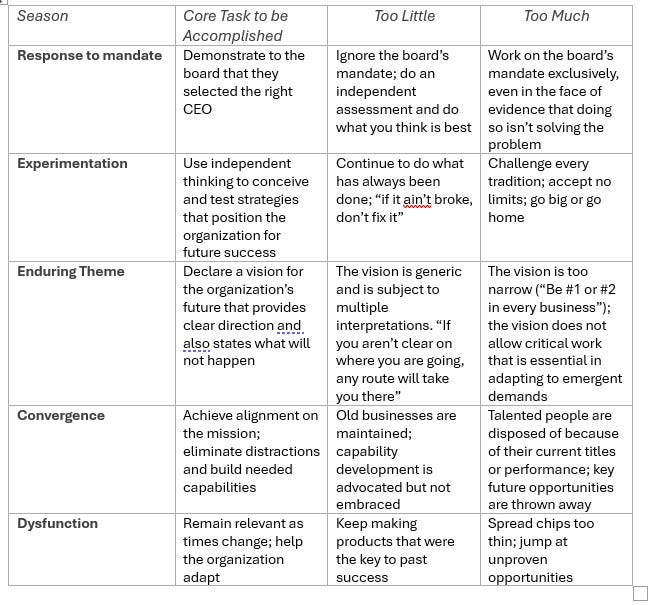
Problems with doing too much or too little in each season tend to crop up when a CEO is either driving too hard to succeed or worrying too much about failure. Finding the right balance can be tricky, especially since the results of strategic decisions take time to show up. The CEO can be far down the stream and committed to a particular approach to the season before they receive clear evidence that they have taken a wrong turn.
To help find the right balance, it’s important to not only listen to what board members and trusted confidants are trying to tell you, but to actively seek feedback and entertain alternatives. In the movie Little Big Man, Dustin Hoffman plays a scout who tries to warn General Custer not to attack at the Battle of Little Bighorn. Custer was hell bent on glory and attacked anyway. We may know of other leaders who made bad decisions in search of success or out of fear of failure. When that leader is us, we need to be sure to listen.